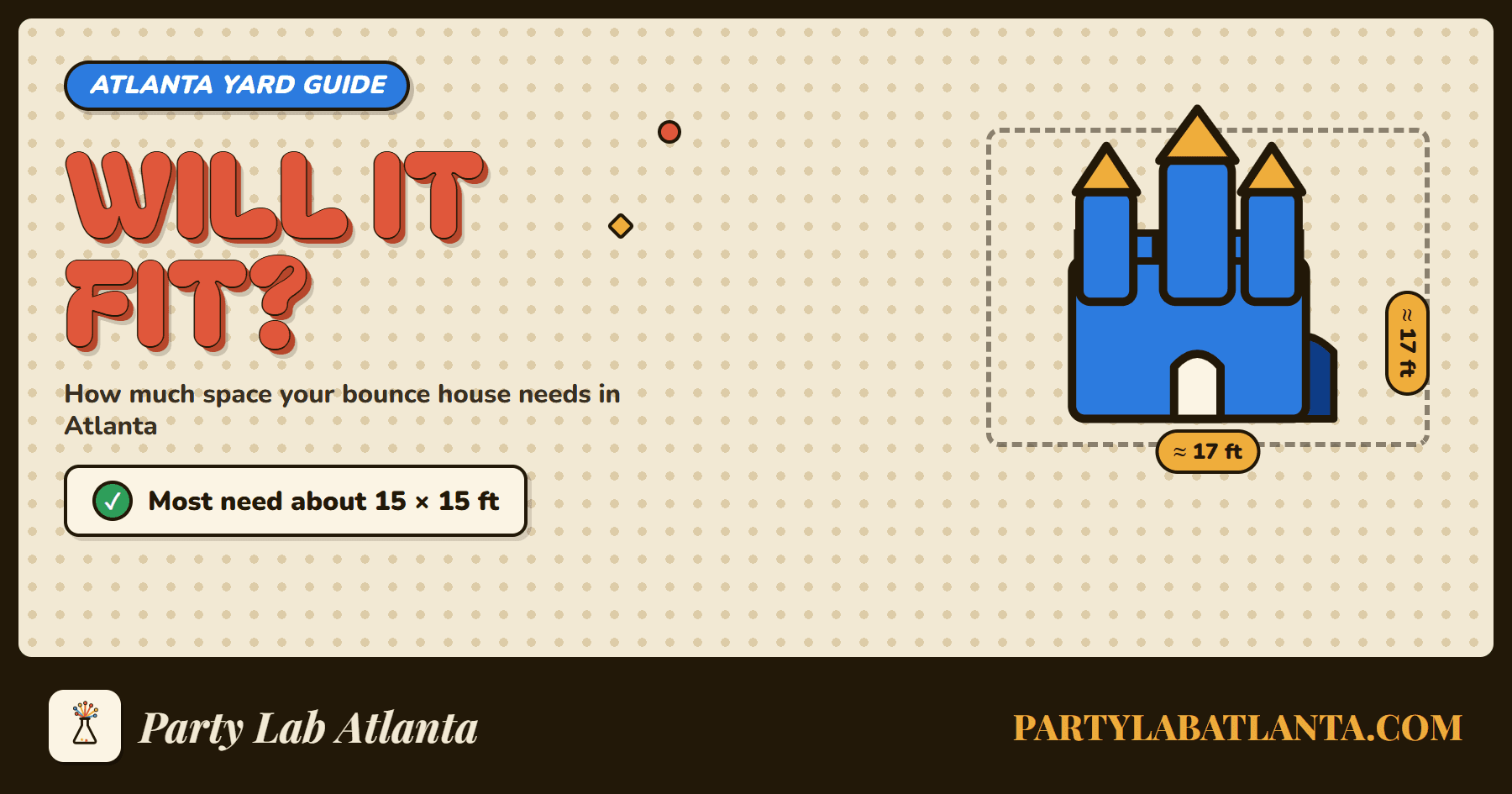
Before you book a bounce house in Atlanta, the one thing worth measuring is your yard. Most standard bounce houses need a flat area of about 15 by 15 feet, plus a few feet of clearance on every side and enough overhead room to clear branches and power lines. Bigger combos and slides need more. Here is how to figure out exactly what fits, so nothing shows up that you cannot set up.
The quick version
A safe rule for most backyard pieces: take the inflatable's footprint and add about 3 to 4 feet on each side, plus 4 feet of open air above the tallest point. You also need a clear path to get it into the yard (a gate around 3 feet wide) and a standard power outlet within roughly 100 feet.
Space by piece
Here is the footprint and the space to actually set aside for each of our inflatables. The "space to set aside" already includes clearance.
| Piece | Footprint | Space to set aside | Overhead |
|---|---|---|---|
| The Atrium (tropical splash) | 10 x 10 ft | about 14 x 14 ft | 12 ft |
| The Marigold (castle combo) | 13 x 13 ft | about 17 x 17 ft | 16 ft |
| The Sundae (slide combo) | 22 x 14 ft | about 26 x 18 ft | 16 ft |
| RampageZone (obstacle course) | 32 x 12 ft | about 36 x 16 ft | 12 ft |
You can see full specs and photos for each on the inflatables page. If you are torn between sizes, our bounce house vs. water slide guide walks through how to choose.
Clearance rules that matter
The footprint is only half the story. Three kinds of clearance keep setup safe and possible:
- Side clearance. Leave 3 to 4 feet around the whole unit. Anchors (stakes or sandbags) sit outside the footprint, and kids need room to climb on and off.
- Overhead clearance. Look up before you pick a spot. Tree branches, deck overhangs, and power lines are the most common reasons a piece will not fit a yard that looks big enough on the ground.
- Access clearance. We roll the unit in on a dolly, so we need a gate or path around 3 feet wide. If your only access is through the house or a narrow side yard, tell us when you book.
Surfaces we can set up on
Grass is ideal because we can stake the unit straight into the ground. We also set up on artificial turf, concrete, and asphalt using sandbags instead of stakes, and indoors at gyms and halls. Just tell us your surface when you book so we bring the right anchoring. The Consumer Product Safety Commission flags poor anchoring as a leading cause of inflatable injuries, so this part is not optional on our end.
How to measure your yard in five minutes
- Pick the flattest, most open spot.
- Measure the length and width with a tape measure or by stepping it off (one big step is roughly 3 feet).
- Compare it to the "space to set aside" column above.
- Stand in the spot and look straight up. Note any branches or wires.
- Check the gate or path width on the way in.
Not sure? Send us a photo of the space along with rough measurements and we will tell you what fits before you pay a deposit.
What if your yard is too small?
You still have good options. A compact piece like The Atrium fits surprisingly tight spaces. You can move the party indoors to a gym or fellowship hall, which doubles as a rain plan. Or you can book a local park, though most Atlanta parks require a permit and a certificate of insurance, which we provide. See the areas we serve and we will help you sort it out.
Frequently asked questions
How much space does a standard bounce house need?
About 15 by 15 feet of flat ground, plus 3 to 4 feet of clearance on each side and room overhead. Larger combos and slides need more, as the table above shows.
Do you need a flat surface?
Yes, as level as possible. A slight slope is usually fine, but a steep or very uneven yard is not safe for an inflatable. Tell us about your slope and we will advise.
Can a bounce house go on concrete or a driveway?
Yes. On hard surfaces we anchor with sandbags instead of stakes. Just let us know the surface when you book.
How much overhead clearance do I need?
Plan for about 12 to 16 feet depending on the piece, and keep the spot clear of branches and power lines.
What if the bounce house will not fit my yard?
Go with a smaller piece, move indoors, or book a park. Send us your measurements and we will match you to something that fits.
Do you need access to power?
Yes, a standard outlet within about 100 feet. If that is not possible, ask us about a generator.