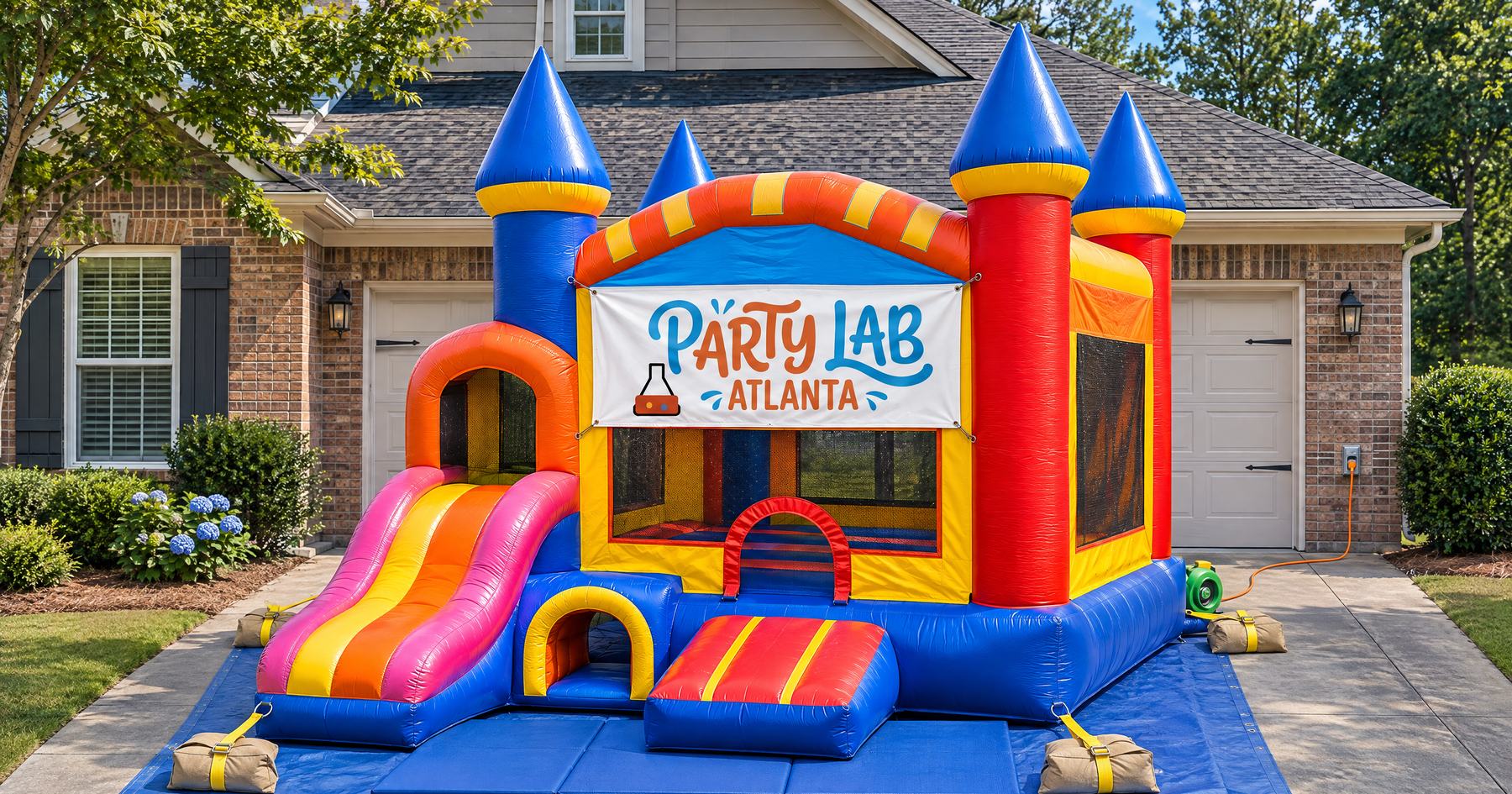
Yes, you can put a bounce house on concrete. We do it most weekends somewhere in metro Atlanta, on a driveway in Conyers or a church parking lot in Covington, and often on a patio where the yard is all slope and shade. The unit doesn't care what it sits on. What changes is how we hold it down, what goes underneath it, and how hot that slab gets by 2 pm in July.
Here is the honest rundown, surface by surface, so you know what to tell us when you book and what to expect when the truck shows up.
Can you put a bounce house on concrete?
Yes. The vinyl floor is thick commercial material, and a clean slab is easier on it than a yard full of pine cones and sweetgum balls. What a hard surface takes away is the stake. Nothing goes into concrete, so the anchoring has to come from weight.
Two things matter here. Tell us the surface when you book, because our crew loads the truck based on what you say, and if we show up expecting grass and find a slab, we need gear we didn't bring. And sweep it. Gravel, acorns, pine bark and broken glass are what scuff vinyl, not the concrete itself.
All four of our bounce house rentals go on concrete, and so do the slides. The Marigold, our 13 by 13 foot castle combo, is the one we set up on patios and indoors most often. If the plan is a gym or a hall, our indoor bounce house guide has the ceiling height and the room checklist.
Stakes or sandbags: how the unit gets anchored
On grass we drive long steel stakes through the anchor straps at the corners and along the sides. On anything hard, every one of those straps gets a sandbag instead. Commercial sandbags for inflatables are typically 40 to 50 pounds apiece, and a unit the size of The Marigold needs one on every strap, corners included.
That weight is why we bring the bags and you don't. Four bags of play sand from the hardware store will not hold a bounce house full of kids when a gust comes through, and no, we can't tie it to the truck either (we get asked). The Consumer Product Safety Commission has said for years that the serious inflatable injuries come from units that were not anchored properly or were used in wind. The fix is boring: real weight at every point, every time.
Our cutoff is the same on every surface. We don't run inflatables when sustained winds pass 20 mph, and on a hard surface we watch the forecast even closer, because the bags are the only thing between the unit and the sky. Here is the quick version for the surfaces we see around Atlanta:
| Surface | Can we set up? | How it is anchored | What to watch |
|---|---|---|---|
| Level grass | Yes, our first choice | Steel stakes | Soggy red clay after rain, sprinkler heads |
| Concrete driveway or patio | Yes | Sandbags on every anchor point | Slope, heat, debris |
| Asphalt | Yes | Sandbags | Heat, soft spots on a 95 degree day |
| Artificial turf | Yes | Sandbags (stakes tear the backing) | Hot in full sun, HOA rules |
| Indoor gym or hall | Yes | Sandbags | Ceiling height, 12 to 16 feet depending on the piece |
| Raised wood deck | No | Nothing holds it | Weight, rails, fall height |
| Gravel or bare dirt | Usually not | Stakes may hold, the surface won't | Punctures, dust, uneven ground |
Is it better to put a bounce house on grass or concrete?
Level grass, if you have it. Stakes are the stronger anchor, the landing is softer when a kid tumbles out the door, the ground stays cooler, and nothing creeps.
But plenty of metro Atlanta yards are not level. Older lots in Decatur and East Point run downhill from the back porch, and newer subdivisions in Rockdale and Newton counties are often red clay under a layer of sod, rock hard by late August. In those yards the driveway is the flattest, firmest spot on the property, and we would rather set up on a level driveway than a sloped lawn every single time.
The price is the same either way. Delivery, setup, anchoring and teardown are included within 35 miles of Conyers, whatever we are anchoring to. If you are working out what a bounce house rental costs in Atlanta, the surface is not one of the things that moves the number.
Can you put a bounce house on a driveway?
Yes, and it is the most common hard-surface setup we do. Three checks before you book.
Size first. A standard two-car driveway runs roughly 20 feet wide, which fits our smaller pieces with clearance but not the long ones.
| Piece | Footprint | Open area we need | Fits a two-car driveway? |
|---|---|---|---|
| The Atrium | 10 x 10 ft | About 14 x 14 ft | Yes, easily |
| The Marigold | 13 x 13 ft | About 17 x 17 ft | Yes, on most |
| The Sundae | 22 x 14 ft | About 26 x 18 ft | Only a long driveway |
| RampageZone | 32 x 12 ft | About 37 x 16 ft | No, it needs a yard or a parking lot |
Then slope. Most driveways have a little pitch so rain runs to the street, and a gentle grade is fine. If a basketball rolls to the curb on its own, call us and describe it. A steep driveway is a no, because sandbags can creep on a slope and every kid inside ends up in a pile against the low wall.
Then look up. Hoops, low branches, string lights and the service line from the pole to the house all need to clear the top of the unit, which means 12 to 16 feet of clear air depending on the piece. Our post on how much space a bounce house needs has the numbers for each one. And park on the street before we arrive, because the unit sits there until we come back for it.
Can a bounce house go on a deck?
On a raised wood deck, no, and we would rather say so on the phone than in your backyard. Eight bouncing kids are a lot of moving load, the sandbags add a few hundred pounds on top, there is nothing to stake into, and the railings put a fall from height right beside the door. A deck built for a grill and four chairs was never meant for that.
A ground-level patio is different. If your "deck" is pavers or a slab sitting on the dirt, treat it like a driveway: sandbags and a sweep, plus a look at the slope. Not sure which you have? Send us a photo when you book.
Does a bounce house work on artificial turf?
Yes, and we see more turf every year on HOA common greens and in backyards where the grass gave up under the oaks. We don't stake turf, because stakes punch through the backing and leave holes the HOA will notice. Sandbags again. Turf also runs hotter than real grass in direct sun, so aim for shade or a morning start from June through September.
If the turf belongs to the community, ask the HOA first. Most metro Atlanta HOAs allow inflatables with notice and a certificate of insurance, which we provide. Our pages on bounce house rentals in Alpharetta and bounce house rentals in Marietta cover how the common-area setups usually go in those two cities.
What should I put under a bounce house?
On concrete or asphalt, a tarp or heavy ground cloth. It stops grit from grinding into the vinyl and keeps the floor cleaner. On grass you don't need anything underneath.
If the unit is running wet, the slab around the exit turns into a puddle and wet concrete is slick. Keep old towels by the steps and put the kids in water shoes, because bare feet get scraped up fast on wet concrete or hot patio stone.
Does a bounce house have to be on flat ground?
As flat as you can manage. A slight slope is fine on any surface. A steep or very uneven spot is not safe, and we will say so.
Grass has one extra wrinkle. Metro Atlanta sits on red clay, which holds water instead of draining it, so a dead flat lawn can stay soggy for a day after a storm. If it rained hard Friday night, walk the spot Saturday morning. A firm driveway beats a squelching lawn.
Concrete in Georgia heat
By July, a slab in full sun is a griddle by 2 pm. The vinyl warms up, and the concrete around the exit is the bigger problem, because that is where bare feet land. Start in the morning or pick the shaded side of the house. Hose the slab down right before the kids go in. Run a wet piece if you can (The Atrium runs wet or dry), and call a freeze pop break every hour so everyone drinks water and somebody counts heads.
Summer afternoons here also bring the pop-up storm. Check the National Weather Service forecast that morning. If a thunderstorm rolls in, everyone comes out until it passes, and if the forecast looks bad the day before, you can reschedule or move to credit up to 24 hours before delivery with no fees.
What to tell us when you book
Five things, and the whole call takes two minutes:
- The surface: grass, concrete, asphalt, turf, or indoors.
- The slope, in plain words. "Pretty flat" or "a ball rolls to the curb" both work.
- What is overhead: trees, hoop, power line.
- The path in. We roll the unit on a dolly and need a gate or walkway about 3 feet wide.
- The nearest outlet. We need one within about 100 feet.
Tell us those and we will bring the right anchoring and the right piece. Call (404) 480-2645 or check availability for your date, and if you are torn between the driveway and the lawn, send a photo of both. We will tell you which one we would pick.
Frequently asked questions
Can you put a bounce house on concrete?
Yes. The unit itself is fine on a hard surface. The difference is anchoring: on concrete, asphalt or turf we weigh down every anchor point with sandbags instead of driving stakes. Tell us the surface when you book so the crew loads the right gear.
Is it better to put a bounce house on grass or concrete?
Level grass is our first choice because stakes hold better and the ground stays cooler. But a level driveway beats a sloped lawn every time, and a lot of metro Atlanta yards are sloped red clay. Pick the flattest firm spot you have.
Can a bounce house go on a deck?
Not a raised wood deck. There is nothing to stake into, the sandbags and a full unit put a lot of moving load on the boards, and the railings put a fall from height right next to the door. A ground-level patio of pavers or concrete is fine and is treated like a driveway.
What should I put under a bounce house on concrete?
A tarp or heavy ground cloth. It keeps grit from grinding into the vinyl and keeps the floor cleaner, which matters when a wet unit is dripping onto a driveway. On grass you do not need anything underneath.
Does a bounce house have to be on flat ground?
As flat as you can manage. A slight slope is fine. If a ball rolls to the curb on its own, describe the grade when you call, because sandbags can creep on a steep driveway and the kids end up piled against the low wall.
Does it cost more to set up on a driveway?
No. Delivery, setup, anchoring and teardown are included within 35 miles of Conyers whatever we are anchoring to. Call (404) 480-2645 with your date and surface and we will tell you which piece fits.