Every spring somebody calls us on a Saturday morning with the same question. The sun is out, the forecast said nothing about storms, and the trees in the backyard are swaying. So how windy is too windy for a bounce house? Our answer is 20 mph sustained. When the wind holds there, the kids come out and the blower goes off, no matter how good the rest of the day looks.
Here is where that number comes from, how to spot 20 mph when you do not own a wind gauge, and what Georgia weather actually does to a backyard party from March through September.
How windy is too windy for a bounce house?
Twenty miles per hour, sustained, is where we stop. It is the cutoff we tell every customer at setup, and it is the same across all of our bounce house rentals, from the smallest unit to the biggest.
Here is the reasoning. A bounce house is a big, light, mostly hollow box. The same thing that makes it fun, air pushing against vinyl walls, makes it act like a sail once the wind gets going. Most manufacturers print a wind limit somewhere between 15 and 25 mph, and the industry safety standard for inflatables, ASTM F2374, uses 25 mph as the absolute top end. We sit under that on purpose. Twenty gives us a margin for gusts, for a kid climbing the wall where they should not be, and for the fact that nobody at a birthday party is standing there with an anemometer.
Would we rather pause a party than take the chance? Yes, every time. Twenty minutes of bored kids is a story. A unit that lifts is a hospital visit.
What wind speed is unsafe for a bounce house, even when it is anchored?
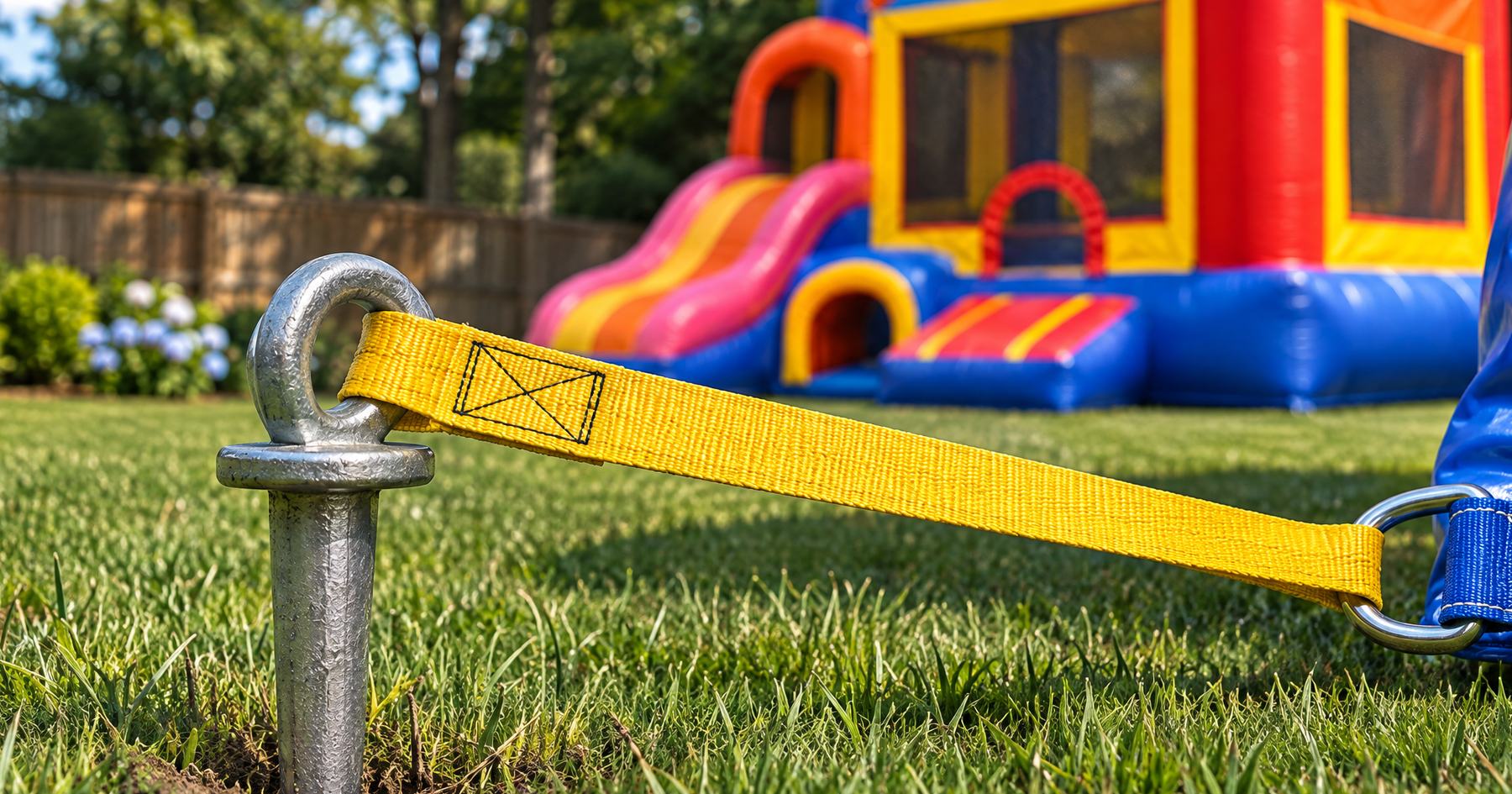
People hear "anchored" and assume that settles it. Anchoring is what holds a unit in place in normal wind. Our crew stakes every anchor point in grass, or weighs each one down with sandbags on a driveway, patio or turf. That handles the breezy afternoons that make up most of our season.
What it does not do is change physics above the limit. The Consumer Product Safety Commission put out a reminder in 2019 because anchored units were still getting swept away. A research team led by a University of Georgia atmospheric scientist went further and counted every wind-related bounce house incident they could find worldwide from 2000 to 2021. Their study found at least 28 deaths and more than 470 injuries, and a striking share happened on days with no weather warning in effect. The wind that lifts a bounce house is usually well below the point where the National Weather Service issues an advisory. That gap is exactly why a rental company needs its own, lower number.
If you are booking with anyone, us or not, ask what their number is. A company that cannot give you one on the phone has not thought about it. More of those questions are in our bounce house safety tips.
How can you tell it is 20 mph without a gauge?
You cannot feel the difference between 15 and 22 mph on your face, but you can see it in the yard. The National Weather Service still uses the old Beaufort scale descriptions, and they work fine from a back porch in Conyers or Marietta.
| Wind speed | What you see in the yard | Bounce house |
|---|---|---|
| Under 8 mph | Leaves rustle, you feel it on your face | Fine |
| 8 to 12 mph | Leaves and small twigs moving the whole time, a light flag stands out | Fine, keep half an eye on it |
| 13 to 18 mph | Dust and loose paper lift off the ground, small branches move | Watch closely. This is the warning zone |
| 19 to 24 mph | Small trees in full leaf sway, the whole canopy moves | Kids out, blower off. Over our limit |
| 25 to 31 mph | Big branches in motion, umbrellas flip, you hear it in the power lines | Nothing inflatable should be standing |
The row to memorize is the third one. If paper plates are leaving the table on their own and the dogwood in the corner is moving at the branches, you are close. If the whole tree is swaying, you are past it.
Sustained wind or gusts: which one matters?
Both, and your weather app shows them separately for a reason. Sustained wind is the steady average over a couple of minutes. Gusts are the short bursts on top of it. Our 20 mph line is for sustained wind, but a day with 12 mph sustained and gusts to 30 is not a 12 mph day. The gust is what grabs the unit.
Our rule of thumb: if the gust number on the forecast starts with a 3, call us before the truck leaves. If gusts are in the mid 20s, we set up and we all keep watching.
When does Georgia actually get windy?
Metro Atlanta is not a windy place most of the year, which is part of why wind catches parents by surprise here. It shows up in two very different ways depending on the month.
| Time of year | What the wind does here | What it means for your party |
|---|---|---|
| March to April | Cold fronts roll through every few days, and the day behind each one is often gusty and bright. This is when wind comes up most on our bookings | Check the forecast two days out. A morning party often beats a 2 pm start |
| May to September | Mostly still and humid, until an afternoon thunderstorm sends a gust front ahead of the rain | The sunny-afternoon gust is the danger. Rain is rarely the first sign |
| October to November | The calmest, driest stretch of the year | The easiest weather we work in |
| December to February | Cold, with the odd windy front and few outdoor bookings | Mostly indoor setups |
Spring is the one that fools people. A blue-sky Saturday in late March, 68 degrees, is often the day after a front, and the wind behind a front can sit at 20 to 25 mph from lunchtime until dark. Those are the days we would rather you book a morning slot.
Summer is sneakier. A July storm cell building over Douglasville or Lawrenceville pushes a wall of cool air out ahead of itself. That gust front can reach your yard ten or fifteen minutes before the first drop of rain, at speeds well past our cutoff, with the sun still shining where you are standing. If the sky to the west goes dark and the breeze suddenly turns cool, that is your cue. Kids out before the rain, not after.
The forecast we trust is the Peachtree City office of the National Weather Service, which covers all of north and central Georgia. Its hourly forecast lists wind speed and gusts side by side, which is exactly what you want the night before.
Can you use a bounce house in the rain?
Rain is a different problem from wind, and most of the time it is a smaller one.
Light drizzle on a water slide or a wet-mode combo is basically what the unit is for. A dry bounce house in a drizzle is a different story, because the vinyl gets slick and the entrance ramp turns into a slide of its own. We slow the group down, pull the littlest kids out, and wait for it to pass. A ten-minute shower is a snack break, not a crisis.
Thunder is where the judgment call ends. Lightning anywhere within earshot means every kid out of the unit, away from it, and the blower unplugged. A bounce house is a wet vinyl structure with a metal blower plugged into your house, and nobody needs to be in it during a storm. Thirty minutes after the last thunder, you can start back up.
The question people really mean when they ask about rain is "what happens to my money," so here it is.
What is Party Lab's rain and wind policy?
| Situation | What happens |
|---|---|
| The forecast looks bad and you are more than 24 hours from delivery | Reschedule to another date or convert to studio credit. No fee |
| Light drizzle on the day | Usually fine. Water units carry on, dry units slow down or pause |
| Thunder or lightning on the day | Everyone out, blower unplugged, wait it out. The unit stays, the party resumes |
| Sustained wind over 20 mph on the day | We do not run the unit. We work with you to reschedule |
We watch the forecast right along with you as the date gets close, and on the day itself our crew makes the call on site. Delivery, setup, anchoring and teardown are included within 35 miles of Conyers, and none of that changes because the weather did. If you want to know what the rental itself runs, we lay out what a bounce house rental costs in Atlanta in plain numbers. The weather policy is the same at every price.
What happens if the wind picks up in the middle of the party?
Two steps, in this order.
Kids out first. Call them off the unit the way you would call them in for cake, calm and all at once. Then turn the blower off. A bounce house deflates in under a minute, and a flat unit lying on the grass does not catch wind the way a standing one does. Leave the stakes and sandbags exactly where they are.
Then wait. Watch the trees, not the sky. Fifteen minutes later, if the canopy has settled back to a rustle, turn the blower on, let it fill, and carry on. If the trees are still swaying, give it another fifteen. We go over this with you at setup, and the number to call if you are unsure is (404) 480-2645. You get a person who can look at the same radar you are looking at.
Booking around the weather
Spring and summer Saturdays go fast, so most families lock a date a month or more out and then watch the sky as it gets close. That is the right order. Our 24-hour rule exists so that a bad forecast costs you a phone call, not a deposit, and most of the time the day turns out fine anyway.
If you are north of the city, we run bounce house rentals in Alpharetta and bounce house rentals in Marietta every weekend of the season. Call (404) 480-2645 or check your date through contact. Tell us the yard, the age range and the time of day, and we will tell you honestly whether a morning or an afternoon slot gives you the better odds with the wind.
Frequently asked questions
How windy is too windy for a bounce house?
We do not run inflatables when sustained winds pass 20 mph. Most manufacturers put their limit between 15 and 25 mph, and the ASTM safety standard for inflatables tops out at 25 mph. We sit under that on purpose, because a unit that lifts is far worse than a party that waits an hour.
What wind speed is unsafe for a bounce house?
Anything over 20 mph sustained, in our book. Gusts matter too. If small trees in full leaf are swaying and loose paper is lifting off the ground, you are at or past the line and the kids should come out while you check.
Can you use a bounce house in the rain?
Light drizzle is usually fine, especially on a water unit where the kids are already soaked. A dry unit gets slick in rain, so we slow it down or pause. Thunder or lightning means everyone out and the blower unplugged until it passes.
What is Party Lab's rain and wind policy?
You can reschedule or convert to studio credit up to 24 hours before delivery, with no fees. If the weather is unsafe on the day itself, we work with you to reschedule. We watch the forecast right along with you.
Does anchoring make a bounce house safe in high wind?
Anchoring is what keeps a unit put in normal wind, and we stake every anchor point in grass and use sandbags on concrete or turf. It is not a license to run in a gale. Past 20 mph the right move is kids out and blower off, however well it is tied down.
What happens if the wind picks up in the middle of the party?
Get the kids out first, then turn the blower off so the unit deflates. A flat bounce house does not catch wind. Wait fifteen minutes, see what the trees are doing, and start it back up if things have settled. Call (404) 480-2645 if you are unsure.